


Industrial Power Supply Selection Guide for Automation, Machinery & Manufacturing (2026)
Selecting the right industrial power supply is essential for reliable automation, machinery, and manufacturing operations. Unstable power causes downtime, equipment damage, and higher costs. This 2026 guide covers the key factors for choosing a suitable unit, with practical recommendations drawn from real industrial applications and solutions from GVE.
Understanding Industrial Power Supply Requirements
An industrial power supply converts AC into stable, regulated DC power for PLCs, sensors, motors, HMIs, and control systems. Unlike consumer units, these models support continuous 24/7 operation, wide temperature ranges, vibration, dust, and electrical noise.
Calculate total continuous load, peak load, and surge currents, then add a 20–30% safety margin. Common output voltages include:
- 24V DC – standard for most PLCs, sensors, relays, and control circuits
- 12V DC – for lower-power sensors and actuators
- 48V DC – for higher-power motors, telecom, or PoE
- 5V DC – for logic circuits and microcontrollers
Wide-range AC inputs (typically 100–240V) improve global compatibility. Explore options on the GVE industrial power supply page.
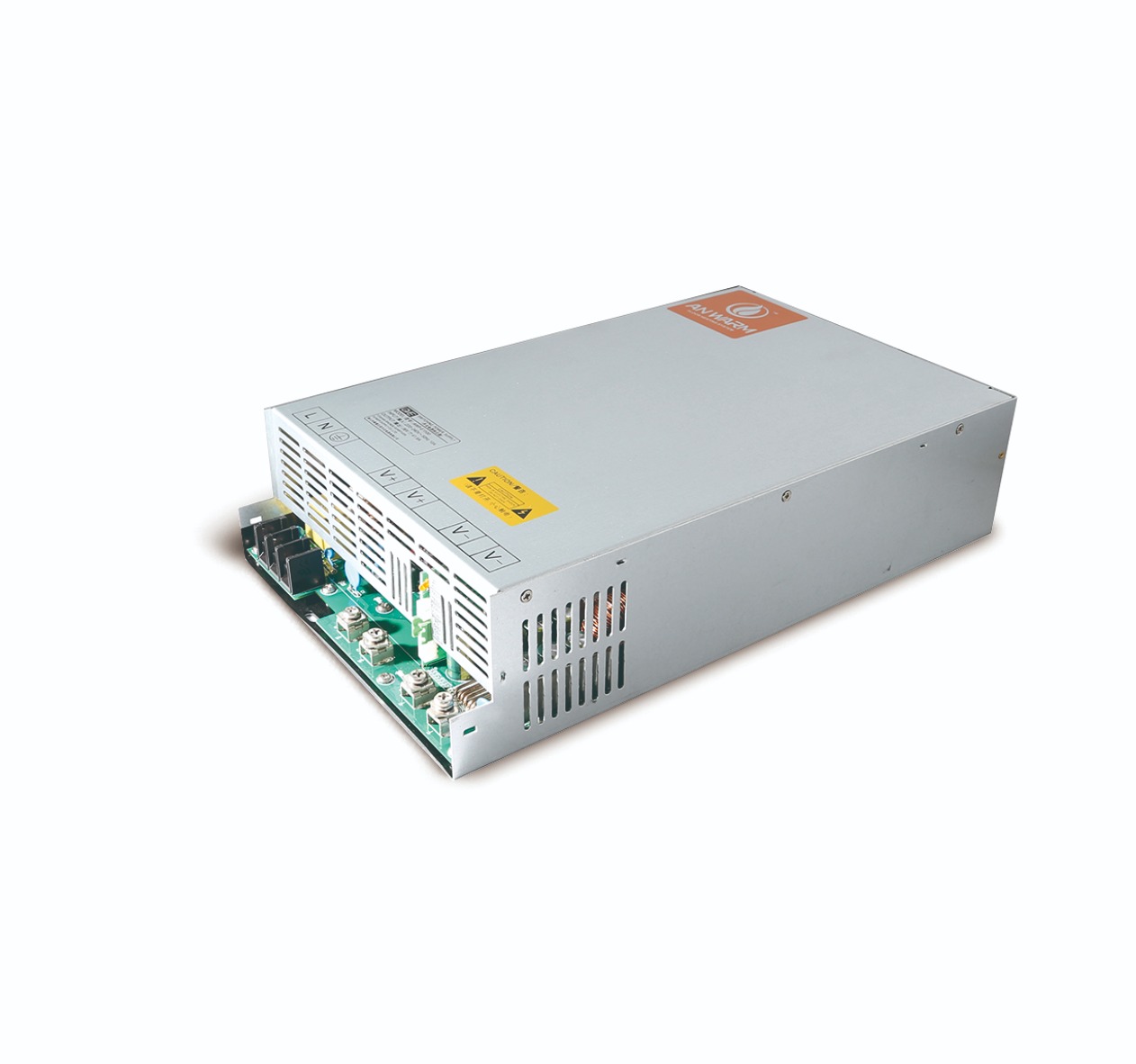
Key Selection Criteria for Automation and Machinery
Voltage Stability and Output Regulation
Choose supplies with tight regulation (±1% or better) and low ripple to protect sensitive electronics and prevent intermittent faults. Constant-voltage designs suit most control systems; constant-current units are better for specialized loads such as certain LED vision systems.
Modular vs Non-Modular Designs
|
Feature |
Modular Power Supply |
Non-Modular Power Supply |
|
Cable Management |
Excellent (detachable cables/modules) |
Fixed cables, more clutter |
|
Space Efficiency |
High |
Lower due to excess cabling |
|
Maintenance |
Easy – replace individual modules |
Requires full unit replacement |
|
Initial Cost |
Higher |
Lower |
|
Ideal Applications |
Complex automation racks, expandable systems |
Fixed-function machinery |
Modular designs work best in expandable control cabinets. Non-modular units suit simpler, static machines. GVE offers both across its industrial range, including the GM800 and GP series.
Efficiency and Thermal Performance
Prioritize Energy Efficiency Level VI or higher to cut energy costs and reduce heat. In sealed cabinets, excess heat shortens component life. Look for wide operating temperature ranges (commonly –20°C to +70°C) and effective thermal design.
Protection Features and Reliability
Essential protections include over-voltage (OVP), over-current (OCP), short-circuit (SCP), over-temperature (OTP), and surge/EMI filtering. High MTBF ratings and quality components further improve long-term reliability. For critical lines, consider N+1 redundancy so one unit can take over if another fails.
Environmental and Installation Considerations
Factories involve dust, humidity, vibration, and temperature extremes. Select units with robust construction and appropriate enclosure ratings. DIN-rail mounting remains the preferred format for most control panels. Higher IP-rated or sealed models suit outdoor or wash-down areas.
Certifications and Compliance
Look for:
- Safety: UL, CE, CB, CCC
- EMC: FCC and relevant EN standards
- Environmental: RoHS, REACH
- Efficiency: DoE Level VI
Certified products simplify international deployment. GVE industrial supplies include EMC certification, RoHS & REACH compliance, and support for customized regional requirements.
Customization and OEM Solutions
Complex machinery often needs tailored voltage/current combinations, connectors, housings, or multi-output designs. Manufacturers offering OEM/ODM support reduce development time. GVE provides customization across its range, from high-power GP3000 units to compact GP250 and GP360 models, all featuring Level VI efficiency, full protection circuits, and flexible outputs suitable for automation, laser systems, charging equipment, and more.
Practical Selection Steps for 2026 Projects
List all loads and calculate continuous plus peak power.
Confirm required output voltages and currents.
Verify input voltage range and facility power quality.
Choose modular or non-modular architecture.
Check efficiency, thermal performance, and protections.
Confirm environmental ratings and certifications.
Assess customization needs and lead times.
Evaluate total cost of ownership.
Test under realistic load and temperature conditions before full deployment.
GVE Industrial Power Supply Solutions
GVE has supplied industrial power solutions for more than two decades. Representative models include the high-capacity GP3000, balanced GM1500 and GM800, and compact GP500, GP360, and GP250 series. All offer Energy Efficiency Level VI, OCP/OVP/OTP protection, EMC certification, and RoHS/REACH compliance.
Review the full range at GVE industrial power supplies. Related reading: Best Industrial Power Supply for Automation and How to Choose the Right Industrial Power Supply.
Conclusion
The right industrial power supply balances performance, reliability, efficiency, and support. Match output stability, protection features, form factor, and certifications to your application. Whether you need a standard DIN-rail unit or a customized high-power solution, proper selection prevents downtime and supports long-term growth. GVE’s industrial power supplies are designed for the demands of modern automation, machinery, and manufacturing—review your requirements and choose a partner that delivers both standard and custom options.